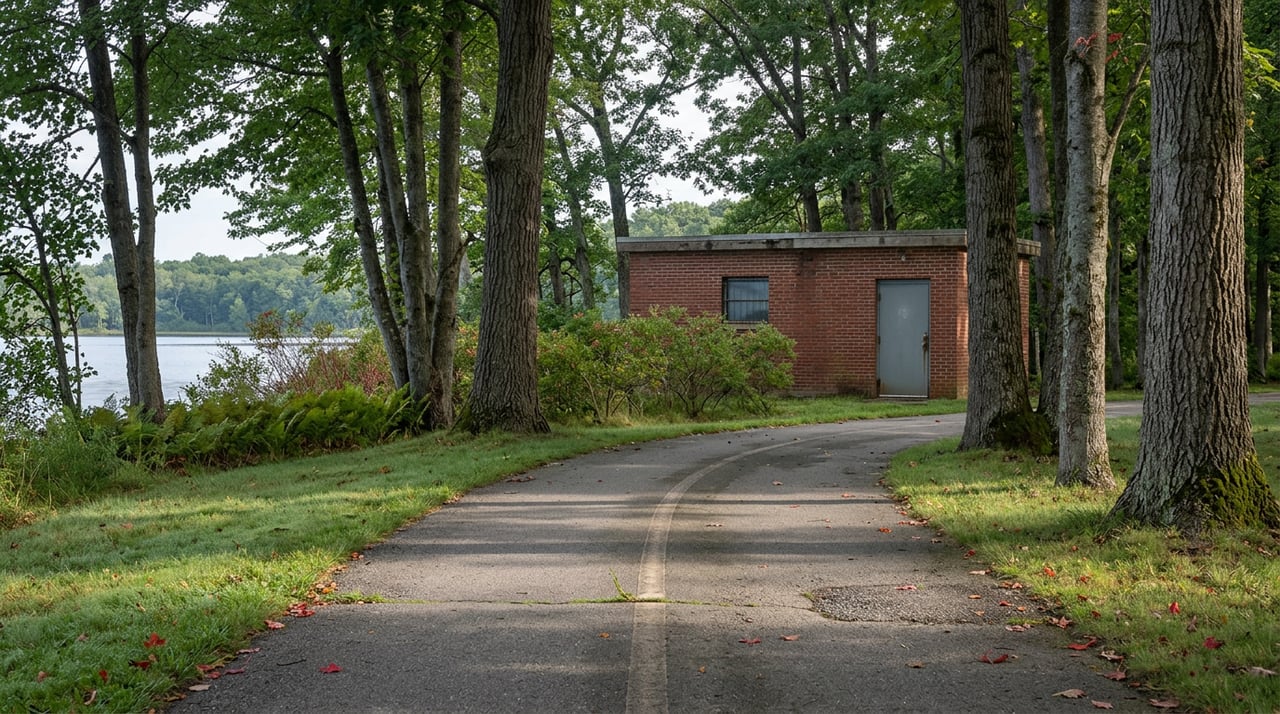
Walk the loop on any weekday morning and Fresh Pond reads like the flagship green space you'd expect in any dense city: joggers working intervals along the water, dogs trotting off leash with no particular urgency, someone's grandmother on her third lap before the heat sets in. Nothing about the scene signals restricted access.
Then someone tries to park a car. Or lets a dog off leash without a Cambridge license clipped to its collar. Or calls in February hoping to buy a season pass to the nine-hole golf course tucked against the water's edge. That's the moment the reservation's actual structure shows itself. This is public land that, in nearly every functional sense a regular user encounters, operates like an amenity reserved for people who can prove they live in Cambridge.
A Reservoir Before It Was a Park
Fresh Pond wasn't built as recreation. Long before anyone circled it for exercise, entrepreneurs were cutting ice off its frozen surface for export around the world. Frederic Tudor, the Boston merchant who became known as the Ice King, built much of his ice trade on Fresh Pond starting in the early 1800s, and one of his employees, Nathaniel Wyeth, grew up on the pond's shores and revolutionized the harvest in the 1820s with horse-drawn ice plows and cutters. By 1847, Boston Harbor was sending out 353 ice-packed vessels a year to ports as far as Rio de Janeiro and Hong Kong, a meaningful share of that cargo cut straight from Fresh Pond, according to Boston University's history of the New England ice trade. The pond spent the next century as an extractable resource before it spent a single day as a public park.
That history still runs the place. Fresh Pond is still an active reservoir, and every tap in Cambridge draws from it after treatment at the Walter J. Sullivan Water Treatment Facility. A working water supply with paths around it isn't the same civic object as a public park, and the access rules track that difference closely, year round.
The Permit That Decides Who Parks
The clearest version of this shows up in the parking lot. The reservation's main paved lot, at Kingsley Park, requires a valid Cambridge resident permit, full stop. The other significant lot, at William G. Maher Park on Concord Avenue, is technically open to anyone, but it sits farther from the loop itself, and more than one visitor account describes driving out to Fresh Pond and never finding a legal place to leave the car.
Here's how that same logic plays out across three of the reservation's most-used amenities:
| Amenity | Cambridge residents | Everyone else |
|---|---|---|
| Parking at Kingsley Park | Permitted with resident sticker | Not available |
| Off-leash privileges on the loop | Allowed with valid Cambridge dog license and voice control | Leash required, 6 feet or shorter |
| Golf season pass, O'Neill course | Priority window, sold out for 2026 | Senior and junior passes only, while available |
None of this is hidden. It's posted and enforced the same way every week. It just isn't obvious from the outside, which is why so much of the loop's daily texture, who's parked where, whose dog is running loose, who bought a pass in February versus who's still waiting, traces back to residency rather than proximity to the water.
Whose Dog Actually Gets to Run Free
Dogs are the most visible test case. The reservation's default rule is a six-foot leash. The exception carved out for off-leash time only applies to dogs licensed in Cambridge, and only if the owner keeps the dog under voice control and off mowed grass areas, a rule that specifically names the large hill by the parking lot as off limits even to trained dogs. A dog belonging to a Somerville or Watertown owner, walked at Fresh Pond just as often as a Cambridge dog, doesn't get the same latitude on paper.
Swimming follows the same split. Dogs can't swim in the reservoir itself, since it's still an active drinking water source, but the adjacent Little Pond allows it, which is why regulars call that corner the dog beach, reportedly the only spot in Cambridge where a dog can legally swim. If an owner wants a fenced space with no leash requirement at all, the two purpose-built dog parks aren't at Fresh Pond. They're at Pacific Field and inside an enclosed area of Danehy Park, both restricted to dogs licensed in the city.
The Golf Course That Sold Out to Its Own Neighbors
The Thomas P. O'Neill Jr. Municipal Golf Course sits inside the reservation, a 3,000-yard, nine-hole layout with three par-3s, four par-4s, and two par-5s running along the edge of the 155-acre reservoir, according to the course's own site. It's genuinely public in the sense that anyone can pay a daily rate and walk on.
Season passes are a different story. Cambridge residents get first access each February, and for 2026 that window closed out demand entirely: the course has already sold out of resident season passes for the year, with only Cambridge senior and junior passes still available on a rolling basis. A non-resident golfer who wants to commit to the course for a full season, rather than pay per round, currently has no path to do that at all. The course is public in the sense that anyone can walk on. It's not public in the sense that anyone can commit to it the way a resident can.
The One Corridor That Isn't Gated
Every rule above has an exception, and it deserves attention because it's the one place non-residents get equal footing at Fresh Pond: the Watertown-Cambridge Greenway. Completed in 2022, the paved, two-mile path connects the Charles River path system and the Minuteman Bikeway on one end to Fresh Pond's own loop on the other, running along the reservoir's eastern edge with no residency requirement to walk or bike through it, per local reporting on the trail.
The greenway has already picked up its own local landmark. At the Belmont Street bridge, a mural titled Slow and Steady, painted by artist Rich Gomez in a graffiti style on the back of a commercial building, has become a fixture regulars point out to first-time visitors. Nobody checks a sticker before you pass the mural. The greenway is the one thread through this entire property where the underlying logic briefly reverses: instead of gating access by residency, the city built a corridor specifically to open the reservation up to Watertown, Belmont, and everyone riding through on the Minuteman.
One Day a Year, the Gates Open Wider
The clearest acknowledgment that Fresh Pond runs on a residency logic the rest of the year is the one day the city deliberately suspends it. This past June 13, the Cambridge Water Department held its 16th annual Fresh Pond Day, a festival built around water, community, and sustainability, open to anyone regardless of address. For one afternoon, the reservation operates exactly the way its paths look the rest of the year: fully open, no permit required, no license check at the gate.
That the city frames this as a notable, named annual event, rather than simply how the reservation always works, is the tell. If Fresh Pond behaved like an ordinary park every day, there would be nothing to mark about the one day everyone gets to use it the same way.
Getting There Without a Sticker
None of this means Fresh Pond is closed to anyone without a Cambridge address. It means the car is the wrong plan. For residents of nearby Somerville, Belmont, or Watertown, or anyone visiting from elsewhere in Cambridge, the loop is easy to reach without a permit, according to trail access notes for the Fresh Pond Bikeway:
- Take the Red Line to Alewife Station, then walk down Fresh Pond Parkway to reach the reservation's north end.
- Ride the MBTA's 72 bus from Harvard Station down Huron Avenue, which stops directly along the Parkway.
- Bike in on the Watertown-Cambridge Greenway from either the Charles River path system or the Minuteman Bikeway, both of which connect without a car.
Once you're on the loop itself, walking, running, and biking are open to everyone in exactly the same way. It's only the car, the leash, and the season pass where the city draws a line most first-time visitors never see coming.
Fresh Pond's rules aren't a secret. They're posted on the city's own site and enforced the same way every week. What's easy to miss, until you've tried to park a car or license a dog somewhere else, is how much of the reservation's daily rhythm actually runs on proof of address rather than proximity to the water. Moving Greater Boston spends as much time learning small, specific rules like these as we do watching prices, because knowing which parks require a sticker and which don't is the kind of detail that tells you someone actually knows this city rather than describing it from the outside. If you're weighing a move into West Cambridge or anywhere near Fresh Pond and want that kind of local read applied to your own search, reach out to Moving Greater Boston.